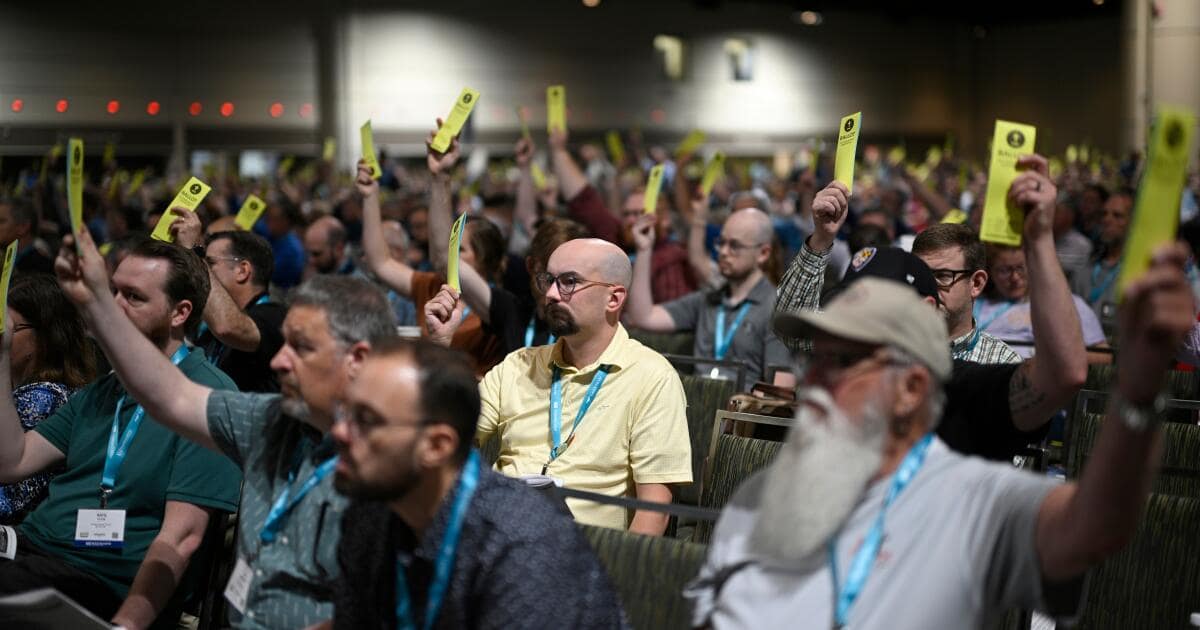
This month in Orlando, the Southern Baptist Convention — the largest Protestant denomination in America — took its first formal step toward barring women from preaching. Almost three-quarters of the voting delegates backed it. The millions of women who fill the pews every Sunday watched their own denomination move, by supermajority, to silence them.
This is hypocrisy striking the heart of American public life.
The U.S. built a foreign policy doctrine in part to stand against the silencing of women. It spent 20 years and more than $2.3 trillion in Afghanistan, with women’s freedom as a stated moral justification. It used the Iranian regime’s treatment of women as a cornerstone of its case for sanctions and diplomatic isolation. USAID poured hundreds of millions into education programs across the Muslim world — with girls’ access as an explicit priority — framed directly in U.S. counterterrorism reports as a tool to counter dangerous extremist ideology.
That doctrine had a vast budget and bipartisan support across four administrations. When thousands of Baptist delegates vote to enact a Taliban mullah policy on American soil, the political class is silent or reaches for the language of “theological disagreement” as an excuse to not speak up. This is a religious cover for a much broader political project: the systematic narrowing of every space where women are permitted to hold authority.
In February, President Trump placed Paula White — a woman pastor — at the head of his newly created White House Faith Office. But the men who hold real power in this administration preach that women should not even have the right to vote.
Keep in mind that this is the administration operating in the shadow of Jeffrey Epstein. America knows what it looks like when powerful men are protected, when girls are failed, when institutions delay and escape accountability. A politics that preaches female submission has very little to say about male impunity.
This is already happening in practice. Defense Secretary Pete Hegseth attends a church whose pastors believe women should not hold leadership positions and that wives must submit to their husbands — views he amplified on social media and appeared to act upon by canceling programs designed to increase women’s roles in national security.
The National Women’s Law Center concluded last year that Trump has not merely rolled back workplace protections, dismantled DEI or stripped reproductive rights — he has attacked the idea that gender equality is a shared national value.
Author and Bible teacher Beth Moore, who served Southern Baptist women for 40 years before the denomination drove her out, has already asked the right question: Which has been the greater problem — women trying to preach, or male pastors who spent decades abusing their congregations while leadership kept a secret list of 700 accused abusers and did nothing? The convention’s response to predatory men was years of silence. Its response to women preaching was a 75% supermajority voting for a ban. The institution has no shortage of decisive action. It is directed against women.
This is not a conflict between church and state. It is a convergence. Religious institutions are the primary pipelines for community leadership in America — civic engagement, local politics, nonprofit work. When women are barred from the pulpit, that shapes who is seen as fit to lead outside the church as well — in communities that are disproportionately Southern, rural and already underserved in many ways.
Meanwhile, the rest of the world is moving in the opposite direction.
This March, Sarah Mullally was enthroned as the 106th archbishop of Canterbury, the first woman to lead the Church of England in its 1,400-year history. Across a different tradition, Mohammed Al-Issa, secretary-general of the Muslim World League, convened representatives of 47 countries in Islamabad alongside Nobel laureates, senior muftis and government ministers and produced the Islamabad Declaration: a formal, unified statement that any use of scripture to restrict women’s rights deviates from the faith itself. Al-Issa was explicit: “No one can claim to speak on behalf of Islam regarding this issue anymore.” That 2025 declaration landed with force. The Taliban’s own leadership has since fractured over women’s rights — senior Cabinet ministers including the interior and defense ministers pushing back openly against their supreme leader’s ban on girls’ education. International religious pressure is doing what $2 trillion of American spending could not.
I have attended diplomatic forums at which women’s rights was America’s signature issue — evidence of its values, its seriousness, its distance from the regimes it opposed. Yet the administration’s new 2026 budget eliminates all funding for women’s reproductive health globally. Its new foreign policy strategy contains no reference to women at all. The U.S. is sacrificing its standing. This credibility is the difference between a country that can demand accountability from others and one that cannot.
The Southern Baptist Convention has made its choice. Now the rest of America’s faith community must make theirs. What is considered “extremism” in America? Right now, the answer depends entirely on who is preaching.
Nathalie Beasnael is a faith elder at Christ Citadel International Church in Los Angeles and founder of Health4Peace. She serves as diplomatic envoy to the U.S. for the Republic of Chad.
Insights
L.A. Times Insights delivers AI-generated analysis on Voices content to offer all points of view. Insights does not appear on any news articles.
Perspectives
The following AI-generated content is powered by Perplexity. The Los Angeles Times editorial staff does not create or edit the content.
Ideas expressed in the piece
-
The article argues that the Southern Baptist Convention’s recent vote to advance a constitutional amendment formally barring women from serving in any pastoral role or preaching to congregations — supported by nearly three-quarters of delegates — is a decisive effort to silence women in the largest Protestant denomination in the United States.[1][2]
-
It contends that this move exposes deep hypocrisy in American public life: U.S. foreign policy has long justified vast spending and military engagement, especially in Afghanistan and in pressure on Iran, by invoking women’s rights as a moral imperative, yet powerful religious and political actors at home now embrace policies the piece likens to those of the Taliban toward women.
-
The column portrays the amendment not as a narrow “theological disagreement” but as religious cover for a broader political project: the systematic narrowing of spaces where women may exercise authority, from the pulpit to civic and political leadership.[2]
-
It argues that, despite appointing a high-profile woman pastor to lead a White House faith office, the broader political movement aligned with this theology includes influential men who openly question women’s right to vote and promote female submission, creating a culture in which powerful men are shielded and girls and women are left unprotected.
-
The article links this theology of submission to institutional patterns of impunity, asserting that churches and denominations that move swiftly and decisively to restrict women’s preaching have long been slow and secretive in confronting male clerical sexual abuse, as illustrated by references to large numbers of alleged abusers whose names were kept from public accountability.
-
It stresses that this is not a clash between church and state but a convergence: because churches are primary pipelines into community leadership and civic engagement, barring women from the pulpit reshapes who is seen as a legitimate leader in broader public life, especially in Southern and rural communities already facing multiple forms of marginalization.
-
The column contrasts the Southern Baptist move with developments elsewhere in global faith communities, highlighting how some Christian and Muslim leaders abroad are issuing formal declarations and making high-level appointments that affirm women’s leadership and explicitly reject scriptural justifications for restricting women’s rights.
-
It argues that, as the U.S. government simultaneously strips references to women’s rights out of foreign policy documents and eliminates funding for global reproductive health, the country is sacrificing the moral credibility it once claimed when pressing other governments on women’s rights and gender-based repression.
-
The piece concludes that the Southern Baptist Convention has made a clear choice against women’s authority and that other American faith communities now face a moral and spiritual test of whether they will align with that project or resist it, raising the broader question of why “extremism” is condemned in some religious contexts but tolerated or normalized in others at home.
Different views on the topic
-
In contrast, Southern Baptist leaders and supporters of the amendment argue that restricting the pastoral office and preaching roles to men is an expression of long-held biblical convictions, not a political “war on women,” emphasizing that their stance flows from a complementarian reading of Scripture about distinct roles for men and women in the church.[1][2][3]
-
Proponents further contend that the proposed amendment provides doctrinal clarity for member churches, ensuring that congregations affiliated with the convention share a consistent understanding of pastoral qualifications, rather than being a mechanism for silencing women’s voices in all areas of church life.[1][3]
-
Supporters often note that women in Southern Baptist churches continue to serve in numerous ministries, including missions, children’s work, women’s programs, teaching in certain settings, and other leadership roles outside the specific office and functions of pastor, presenting this as evidence that the denomination does not reject women’s contributions but seeks to follow what it understands as scriptural limits.[2][3]
-
Some Southern Baptist commentators argue that critics mischaracterize the amendment as comparable to Taliban policies, insisting that the convention’s polity is voluntary, that churches can leave if they disagree, and that the issue is internal church governance rather than state coercion or broad social subjugation of women.[1][3]
-
Defenders also dispute the framing of the vote as primarily about abuse and impunity, stating that the convention has taken recent steps to address sexual misconduct and improve protections, and that its debates over women pastors are about theology and denominational identity rather than an attempt to deflect attention from scandals.[3]
-
Moreover, some evangelical leaders maintain that U.S. foreign policy on women’s rights and the internal decisions of a religious denomination should not be conflated, arguing that a pluralistic democracy must allow faith communities to order their leadership according to their doctrines even when those doctrines conflict with prevailing cultural or political norms.[1][3]
-
Finally, supporters caution that pressuring or stigmatizing denominations over complementarian beliefs risks infringing on religious freedom and could deepen polarization, arguing that robust constitutional protections must apply equally to religious traditions whose gender teachings are unpopular as well as to those that champion gender equality.[1][3]