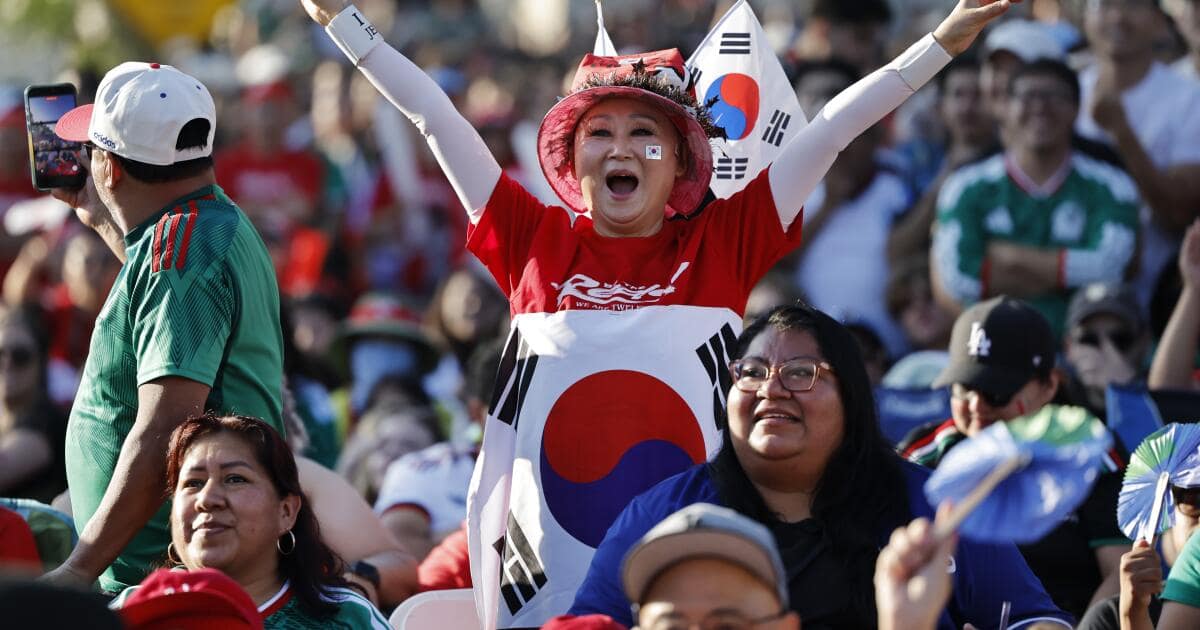
Streets of Koreatown were painted green and red last Thursday for one of the most anticipated games of the World Cup’s group stage: South Korea vs. Mexico. Restaurants and bars overflowed with fans, watch parties spilled into parks and parking lots, and chants in Korean and Spanish echoed through the neighborhood. For a few hours, one of Los Angeles’ most diverse communities became the center of the World Cup.
Since the games kicked off two weeks ago, the world has been captivated by the stories that emerge whenever dozens of nations are brought together in one tournament. We have already seen underdogs surprise the world, historic rivals renew old grudges and players forge friendships across national and cultural lines. But one of the tournament’s most compelling stories began even before the first kickoff: the unlikely but genuine friendship between South Korea and Mexico, two countries separated by an ocean and a language, yet united by a surprising sense of affection.
In the weeks leading up to the tournament, I have been seeing countless videos of Korean fans arriving in Guadalajara, Mexico, and being greeted with hugs, kisses, chants of “¡Coreano, hermano, ya eres mexicano!” (“Korean, brother, you’re already Mexican!”) and even free shots of tequila. Many people in South Korea reacted with a mixture of amusement and surprise as the two countries at opposite ends of the Earth rarely have opportunities to interact. From the outside, it might seem as though this friendship began in 2018, when South Korea’s dramatic victory over Germany helped Mexico advance to the knockout stage. But as someone who has lived in L.A. since immigrating from South Korea 20 years ago and spent the last four years living in the heart of Koreatown, none of this surprises me.
The name “Koreatown” naturally suggests a neighborhood where most residents are Korean or Korean American. That may have been true at one point in L.A. history, but it is far from the full story today. Anyone who has driven down 8th Street knows this. One moment, you pass Jinsol Gukbap, where they have authentic Korean pork soup; a few blocks later, you see the signs for Sabores Oaxaqueños, where you can enjoy delicious Oaxacan meals and drinks.
The pattern continues throughout the neighborhood: Korean businesses stand alongside Latino-owned restaurants, street vendors, and family-run shops. For decades, Koreatown has been home to both Korean immigrants and Latino families, many tracing their roots to Mexico and Central America, and the cultural exchange is woven into everyday life. Many of my Korean American friends grew up eating tacos as often as they ate Korean food, while many of my Mexican American friends know at least a few words in Korean or random traditional Korean games. Koreans and Mexicans have lived, worked, and raised families alongside one another for generations, sharing not just a neighborhood but a community.
Although South Korea and Mexico sit on opposite sides of the world, the two communities in L.A. often have more in common than one might expect at first glance. Their immigration stories are different, but both are shaped by groups of hardworking people who have crossed the ocean and the border to build new dreams and better futures for their children. This often means the sacrifices of the parents’ generation, stories written into the calloused hands of those who spent long hours working in Korean-owned laundromats and Mexican-owned mercados.
Both communities place a strong emphasis on family and community, centered around and powered by local churches and multi-generational gatherings. Most importantly, and what I think brought these specific two groups so close so quickly, is that we are both passionate, we love to drink and we enjoy a good time. So the friendship between Koreans and Mexicans is hardly surprising. What many people are witnessing in Mexico this summer is not a new phenomenon born out of a single World Cup result in 2018, but rather a relationship that has been developing for decades in cities like Los Angeles. In many ways, seeing this camaraderie on display in Mexico feels reassuring, as if it is a reminder that the connections built between our communities in places like Koreatown are real and enduring.
Like many fans, I had mixed feelings going into the match last Thursday. After weeks of celebrating the friendship between the two countries, it was almost heartbreaking to think that we would have to turn against one another for 90 minutes. At one of the biggest block watch parties in Koreatown, held at Seoul International Park this past Thursday, however, the bond was still strong between the two groups. People in red and green excitedly chanted “México, México!” followed by “Korea! Korea!” together. I saw a Mexican man in a lucha mask taking pictures with a Korean man who had his face painted like the South Korean flag. I also made new Mexican American friends who sat next to us and shared snacks and drinks.
Even during the game, where the tension was high, we exchanged high-fives after great saves and attacking chances from both sides. The crowd erupted in cheers and celebration when the final whistle blew, and despite South Korea’s loss, I wasn’t sad. The result felt secondary to what I had witnessed all afternoon: a reminder that the friendship between these communities is bigger than any single match. Long after the World Cup moves on to its next host city and its next unlikely pairing of nations, Korean and Mexican families will still be sharing the same streets, schools and neighborhoods in Los Angeles.
YoonJu Lee is a Korean language teacher who has been living in Los Angeles since immigrating from South Korea 20 years ago.