
Conservatives routinely use images of encampments and boarded-up storefronts to criticize progressive policies on the coasts, but 80% of the country’s 341 “persistent poverty” counties are in the South.
In fact, the highest concentration of poverty is in states that have been entirely controlled by conservatives for well over a decade. We’re talking Alabama, Georgia, Mississippi … you know, a lot of the same states that attacked the United States during the Civil War. The same states that opposed civil rights for Black people 50 years ago. The same states that are racing to redraw congressional maps with the intention of stripping political power away from Black people today.
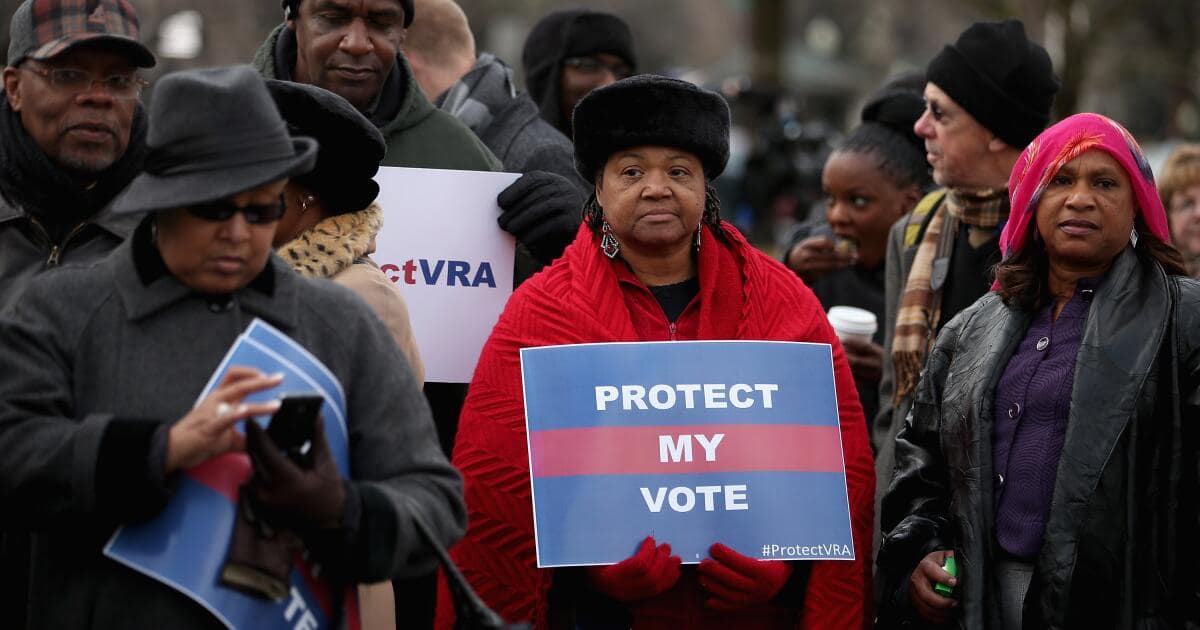
This week the NAACP launched “Out of Bounds,” a campaign calling on Black athletes, fans, alumni, and families to withhold athletic and financial support from public universities in states that have moved to redraw congressional maps. The boycott is in response to a series of Supreme Court rulings — beginning with Shelby County vs. Holder in 2013 — that have weakened the Voting Rights Act of 1965.
Shelby, by the way, is not even among Alabama’s 19 most impoverished counties. All of those are in the Black Belt, a region of the country dominated by abandoned cotton plantations and former sharecroppers. Shelby, on the other hand, is predominantly white and among the state’s most affluent. So when county leaders sued the U.S. government, it wasn’t to gain power for disenfranchised residents as much as it was to strip it away from their poorer neighbors.
Nearly 42% of the country — an estimated 141 million people — currently live in states where Republicans control the governor’s mansion and both state chambers of the state legislature. Not all of them target their Black residents as blatantly, and as ruthlessly, as Alabama, which has largely succeeded in keeping Black residents poor and concentrating wealth in white counties. Yet it happens enough in red states that a map of the counties experiencing persistent poverty for the past 60 years overlaps with a map of the former Confederacy. And that map overlaps with a map of the states the century-old NAACP is targeting with its boycott.
Should Black athletes take up the call?
Yes. Everyone should.
Between 1932 and 1965, the following events unfolded in the world of sports: Jesse Owens makes a mockery of Hitler’s white superiority theory in 1936; Joe Louis becomes heavyweight champion of the world; Kenny Washington breaks the color barrier in the NFL; Jackie Robinson does the same in baseball; and a college senior by the name of Arthur Ashe wins the NCAA singles titles. And yet, despite witnessing all of that success, the leaders of the Southeastern Conference, which began in 1932, stayed committed to racial segregation. Of course, that would be astonishing if not for the fact that the schools that originally made up the SEC were based in former Confederate states.
And even after the conference integrated, Kentucky’s Adolph Rupp refused to recruit Black players for years. He did this even after a team from the former Confederate state of Texas won the NCAA title with an all-Black starting lineup.
Racism doesn’t just harm the intended target. It’s like a gun that fires bullets in every direction, including back toward the gunman.
The past decade of political attacks conservatives waged against critical race theory and “woke” were never about moving us into a post-racial society. The attacks were always in pursuit of the vision of former Alabama Gov. George Wallace: a segregated society. The same is true of the recent push to redraw congressional maps heading into the midterm.
This is why I suspect many Black athletes will heed the NAACP’s call. Not because they are “woke” but because they are paying attention.
There have always been Black athletes — from heavyweight boxing champion Jack Johnson in the early 1900s to Lew Alcindor (the future Kareem Abdul-Jabbar) in 1968 to the WNBA players in the bubble in 2020 — who have been willing to use their platforms to address racial injustice.
However, the reason we continue to have these inflection moments is because too many white people continue to view America’s racism as a problem for Black people. As if the racially motivated upheaval surrounding congressional maps doesn’t affect everyone. This disconnect epitomizes why Rupp has an arena named after him in Kentucky and Gov. Ned Breathitt — who worked with Martin Luther King Jr. and in 1968 made Kentucky the first Southern state to outlaw racial discrimination in public accommodations and employment — is in relative obscurity. Perhaps if we told more of America’s true history, we would discover more of America’s true heroes.
Because even though the South lost the Civil War, the grievances of the defeated in some states continue to outweigh what is in the interest of those states and the country.
If boycotting sports in the South can help end this senseless cycle, that would benefit all of us.
YouTube: @LZGrandersonShow
Insights
L.A. Times Insights delivers AI-generated analysis on Voices content to offer all points of view. Insights does not appear on any news articles.
Viewpoint
Perspectives
The following AI-generated content is powered by Perplexity. The Los Angeles Times editorial staff does not create or edit the content.
Ideas expressed in the piece
-
The column argues that a sports boycott of states engaging in racially discriminatory voting practices is both justified and necessary, framing the NAACP’s new “Out of Bounds” campaign as a legitimate escalation in response to a decade of Supreme Court decisions, including Shelby County vs. Holder, that have weakened the Voting Rights Act and enabled aggressive gerrymandering aimed at diluting Black political power.
-
It links present-day voter suppression to a longer historical continuum, noting that many of the targeted states are former members of the Confederacy that once fought to preserve slavery, later resisted civil rights legislation in the 1960s, and now lead efforts to redraw congressional maps in ways that diminish Black representation, suggesting that the same underlying grievance politics continue to drive policy.
-
The piece emphasizes that persistent poverty is highly concentrated in the South and in states long controlled by conservative governments, arguing that these policy choices have systematically kept many Black communities poor while preserving wealth and political influence in predominantly white counties; the Shelby County plaintiffs are cited as an example of relatively affluent, mostly white officials seeking to curtail protections designed to aid poorer, often Black residents.
-
Drawing on sports history, the column highlights how major milestones—Jesse Owens’ performance in Nazi Germany, Joe Louis’ heavyweight title, Jackie Robinson’s integration of Major League Baseball, Kenny Washington’s NFL breakthrough, and Arthur Ashe’s collegiate success—failed to move Southern sports power structures such as the Southeastern Conference away from segregation for decades, illustrating how deeply entrenched institutional racism has been in those regions.
-
By invoking Kentucky coach Adolph Rupp’s long resistance to recruiting Black players even after an all-Black starting lineup from Texas won the NCAA title, the article suggests that sports institutions in the South have often clung to segregationist practices despite clear evidence that integration benefits both competition and society.
-
The column situates modern athlete activism within a century-long tradition, noting figures such as Jack Johnson, Lew Alcindor (Kareem Abdul-Jabbar), and WNBA players in the 2020 “bubble” as part of a broader history in which Black athletes have used their prominence to confront racial injustice, and it contends that this history bolsters the moral authority of contemporary calls for boycott.[2]
-
It further argues that racial injustice in voting and representation is not solely a “Black problem” but a structural threat to democracy that ultimately harms entire states and the country; racism is described as a weapon that injures everyone, including those who benefit in the short term from discriminatory policies.
-
The piece contends that widespread indifference among white Americans to racial inequities explains why segregationist figures like Rupp are publicly honored, while politicians such as Kentucky Gov. Ned Breathitt, who worked with Martin Luther King Jr. and signed landmark civil rights protections, remain comparatively obscure; it suggests that more honest teaching of American history would elevate such “true heroes” and shift public values.
-
Ultimately, the column supports broad participation in the NAACP’s proposed boycott—by Black athletes, fans, alumni, and allies of all races—on the grounds that refusing to lend athletic talent, attention, and money to public universities in states undermining Black voting power could exert nonviolent economic and reputational pressure that helps break a recurring cycle of racist policy-making.
Different views on the topic
-
In a policy point–counterpoint debate on African American athlete activism, one side supports protest in sports, but the counterpoint cautions that highly visible athletic protests can deepen polarization, alienate segments of the fan base, and risk reinforcing the perception that sports are being inappropriately politicized, potentially undermining the inclusive, cross-racial appeal that makes athletic platforms powerful in the first place.[2]
-
The counterpoint perspective also raises concerns that sustained political protest or boycott activity places disproportionate burdens on Black athletes themselves, who face career risks, loss of endorsement income, and institutional retaliation, while political elites and governing bodies that shape voting rules remain comparatively insulated from consequences.[2]
-
Scholars and commentators in that debate note that while athlete activism can strengthen racial solidarity and identity, it may not reliably translate into policy change, suggesting that strategies focusing on voter registration, litigation, or coalition-building might be more effective than broad-based sports boycotts that are symbolically potent but politically indirect.[2]
-
Historical research on the proposed boycott of the 1968 Olympic Games documents significant ambivalence among Black athletes, many of whom hesitated to endorse a boycott unless a large majority supported it, citing the loss of years of training, the potential squandering of a rare global stage, and fears that sitting out would cede visibility rather than leverage it.[1]
-
That same scholarship shows that some athletes preferred to compete and use medal ceremonies or media access to highlight injustice, arguing that performance on the field could challenge racist assumptions and inspire Black communities more effectively than absence from competition, a view that implicitly favors engagement over withdrawal as a strategy of resistance.[1]
-
Drawing on these debates, critics of large-scale sports boycotts in “racist states” contend that withholding participation from public universities in conservative states could unintentionally harm local Black communities—coaches, staff, small businesses, and students whose livelihoods and opportunities are tied to athletic programs—more than it pressures state legislators or members of Congress who design and defend restrictive voting maps.[1][2]
-
Opposing views also warn that boycotts targeting entire states risk oversimplifying complex political landscapes by treating millions of residents as a monolith; this approach, critics argue, may stigmatize activists, voters, and institutions within those states that are already fighting gerrymandering and voter suppression from the inside, potentially weakening in-state coalitions for reform.[2]
-
Commentators skeptical of athlete-led boycotts argue that the responsibility for protecting voting rights should rest primarily with elected officials, courts, and advocacy organizations, not with student-athletes and professionals whose primary roles are educational and athletic; from this vantage point, heavy reliance on sports boycotts can be seen as a symptom of institutional failure rather than a sustainable remedy.[2]
-
Finally, some analysts argue that targeted engagement—such as athletes speaking out while continuing to play, partnering with local organizers, or directing resources toward voter education in affected states—may preserve the unifying power of sports while still confronting racism, and therefore offers a more balanced alternative to the sweeping withdrawal of talent and support envisioned in statewide boycotts.[1][2]